AI Adoption Is Visible. AI Fluency Is Not. We’re Committing to the Research.
Two Prune is beginning a research programme—and inviting academic collaboration—to develop task-bounded AI-fluency assessment into a responsible measurement method.
Two Prune Research··5 min read
AI adoption is visible. AI fluency is not.
That visibility gap is why Two Prune is making a public research commitment. We are working to develop task-bounded AI-fluency assessment through internal research and external academic collaboration.
The work starts with construct boundaries, evidence-centred scenario design, integrated process-and-outcome evidence, opportunity-to-observe, explicit missingness and confidence handling, and a responsible validation programme. These are not supporting details around the product. They are the path from a promising product architecture to a defensible measurement method.
We are in early conversations with researchers and labs working across HCI, assessment, learning science and human–AI collaboration. These are early conversations, not announced partnerships. We are publishing the direction now because the construct should be challenged while it is being developed—not presented later as a finished answer.
The need is concrete. Organizations can see who completed an AI course. They can count logins, prompts and active users. They can ask people how confident they feel, test their knowledge of prompting, or inspect the finished work. All of that can be useful. None of it, by itself, reveals how a person actually handled the work.
The same output can conceal two different workflows
Imagine two people receive the same source pack and produce similarly polished recommendations.
One person frames the decision before prompting. They notice that two sources cover different periods, ask AI to surface contradictions, check the material claims against the original evidence and state what remains uncertain. They use AI extensively, but retain control over the conclusion.
The other accepts an elegant synthesis containing an unsupported assumption. The document reads just as well. A final-output review may make the two people look identical.
The reverse problem also occurs. A careful, selective user may appear less advanced than a high-volume user who rarely challenges an answer. Usage tells us that AI was present. It does not tell us whether the human used it well.
Existing measures capture useful pieces
The answer is not to dismiss existing approaches. AI-literacy scales can reveal perceived capability and attitudes. Knowledge tests can assess whether someone understands important concepts. A 2024 systematic review identified 16 validated AI-literacy scales across 22 studies, including both self-report and performance-based measures, while also finding that evidence for some measurement properties remained incomplete.[1]
Put the framework to work
See how your workforce demonstrates AI fluency.
Two Prune uses realistic work simulations to produce structured assessment evidence—not automated employment decisions.
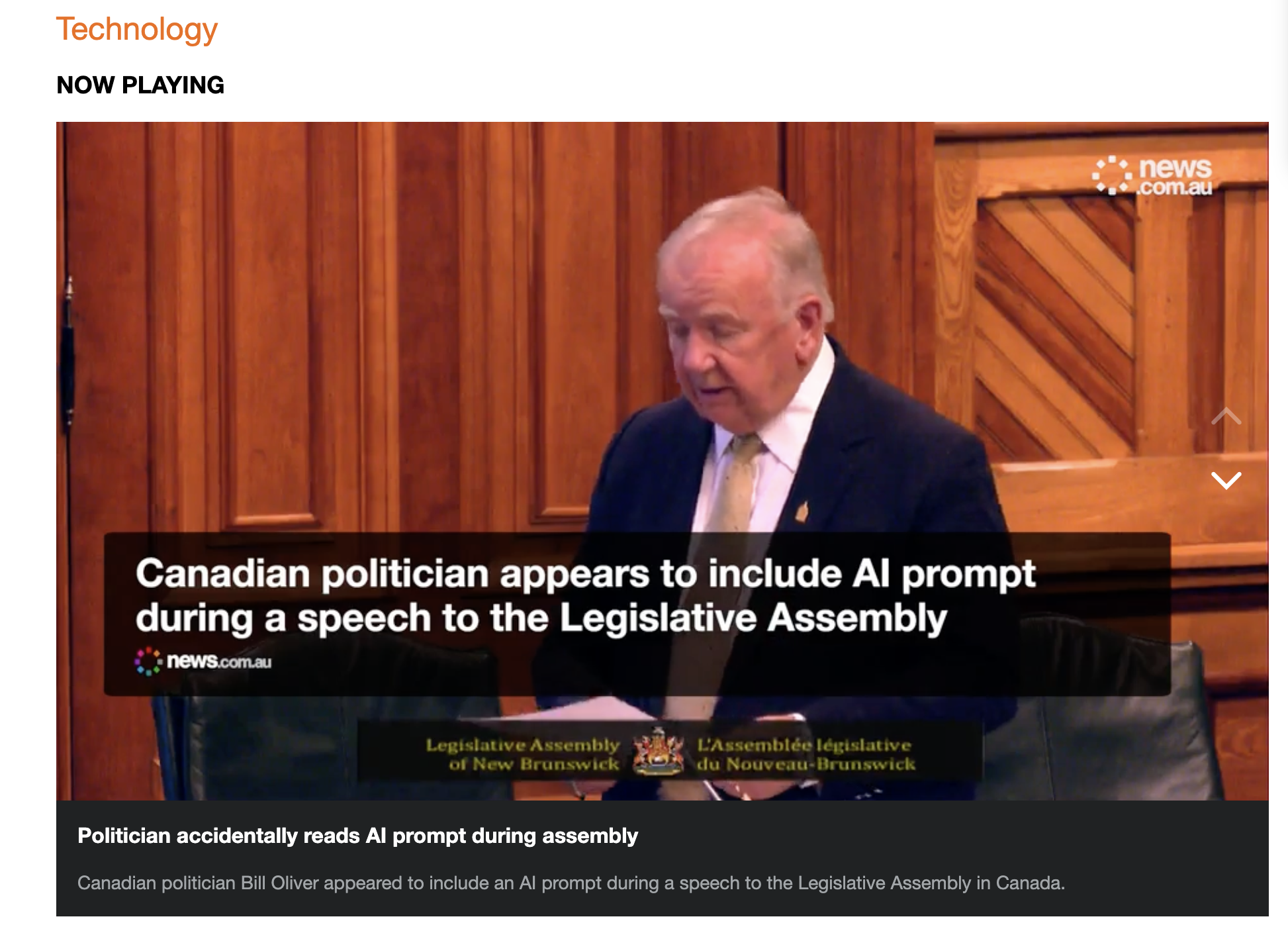
A stray AI editing note in a legislative speech shows why exploration, production and delivery need clear boundaries.
21 July 2026 · 3 min read
Objective tests add another useful layer. GLAT, a 20-item generative-AI literacy assessment studied with higher-education students, found that tested knowledge predicted performance in the study's AI-supported tasks better than perceived ChatGPT proficiency.[2] Recent task-centered research also includes prompting, ethical use, comparing outputs, verification and producing a quality result.[3]
Human–computer interaction research contributes a further distinction: using AI is not the same as relying on it appropriately. In bounded advice-taking studies, appropriate reliance involves accepting correct advice while rejecting or correcting incorrect advice.[4]
These traditions capture useful but different pieces—self-perception, knowledge, task-centered skills, process traces and reliance decisions. We see an underdeveloped opportunity to connect them across a complete, bounded AI-assisted work episode.
A working construct: task-bounded AI fluency
We use task-bounded AI fluency as a working construct: the observable capacity to frame, conduct, verify, and communicate a realistic task with AI support while retaining human judgment, evidence discipline and accountability under specified conditions.
Every part of that definition sets a boundary. Observable means conclusions should connect to evidence rather than confidence alone. Realistic task means the person has a credible objective, audience, constraints and source material. With AI support means the assessment includes the tool as part of the work rather than treating it as outside assistance. Under specified conditions means the result belongs to that task and environment; it is not a universal label.
Our current product framework uses six connected lenses: Context Framing; Evidence Navigation; AI Orchestration; Verification & Risk Control; Judgment & Synthesis; and Communication & Delivery. They are a practical way to organize observations and guide research. We are not presenting them as empirically established factors.
This is why we prefer task-bounded AI-fluency assessment to testing. A single score can create an illusion of completeness. A more responsible account makes the task, evidence, inference and uncertainty visible.
The commitment: develop the method under academic scrutiny
Two Prune provides structured assessment evidence from timed, realistic work simulations. Because the product sells evidence, the meaning and boundaries of that evidence must be defensible.
That is why we are committing to advance this area through internal research and external academic collaboration. The aim is not borrowed prestige. It is to test whether a promising product architecture can develop into a responsible measurement method—and to be explicit about what the evidence cannot yet support.
Our research programme is focused on:
construct boundaries: defining which claims belong inside task-bounded AI fluency and which do not;
evidence-centred scenario design: beginning with the claim, the evidence that could support it and the task conditions needed to elicit that evidence;[5]
integrated process-and-outcome evidence: interpreting the submitted work alongside deliberately structured traces of the work episode, rather than treating generic activity logs as proof;[6]
opportunity-to-observe: checking whether a scenario genuinely gave a participant the chance to demonstrate the behaviour being interpreted;
explicit missingness and confidence handling: Missing evidence reduces confidence; it is not evidence of poor performance.
a responsible validation programme that tests reliability, validity, fairness and appropriate use before stronger claims are made.
Large-scale assessment provides useful design precedents without settling the AI-fluency question. OECD's adaptive-problem-solving framework, for example, treats problem solving as dynamic and uses both item scores and selected log-file indicators to illuminate parts of the process.[7] The lesson is not that every click is meaningful. It is that process evidence must be designed and interpreted against a clear evidentiary argument.
External scrutiny matters because the hard questions are not Two Prune's alone to answer. What belongs inside the construct? Which observations can support which claims? When is evidence too sparse? Where might a scenario or interpretation create unfairness? Those questions require methods and perspectives from beyond one company.
An invitation to challenge the construct
The long-term opportunity is to connect AI-literacy theory, HCI research on human–AI reliance, performance assessment and Evidence-Centred Design into an end-to-end method for realistic AI-assisted work.
That method will need challenge, replication and limits. It should preserve human interpretation rather than automate consequential decisions. Two Prune is a desktop AI-fluency assessment platform; it does not replace human judgment. Its reports are intended for human interpretation, and task evidence remains bounded to the assessed conditions.
If you work in HCI, performance assessment, learning science, psychometrics or workplace AI, we would like to hear from you. Challenge the construct. Help design studies. Test what the evidence can responsibly support. Contact us at hello@twoprune.com.
A participant case note showing why a strong AI-assisted synthesis still needs a separate, deliberately sceptical verification pass against its sources.